
Search Ashland County Police Blotter
Ashland County police blotter searches usually begin with the sheriff's office, then move to the county clerk or the state crash system if the record points in that direction. That order matters in a small county where one office may hold the incident report while another office holds the next step. If you want to find a call, confirm a report, or trace a case after the first page, the right date and place can shorten the search. This page keeps the Ashland County police blotter path simple and local.
Ashland County Police Blotter Overview
Ashland County Police Blotter Sources
The Ashland County Sheriff's Office is at 220 6th St E in Ashland, and the office phone is (715) 685-7640. The open records page at ashlandcountywi.gov/sheriff_open_records is the best place to start when you want a law enforcement record. The main sheriff site at ashlandcountywi.gov/sheriff gives the wider office picture, including jail and patrol information. That is useful when the blotter line is brief and you need to know which part of the office handled the event.
Ashland County also keeps a county clerk office at 201 West Main Street, Room 102, in Ashland. The clerk's phone is (715) 682-7000, and the email listed in the research is publicrecords@co.ashland.wi.us. That office can help point you toward county records after a sheriff report or court filing. A local search often works best when you keep the sheriff, the clerk, and the date in the same sentence.
For a visual checkpoint, the sheriff's main site at ashlandcountywi.gov/sheriff is the source for the first image below.
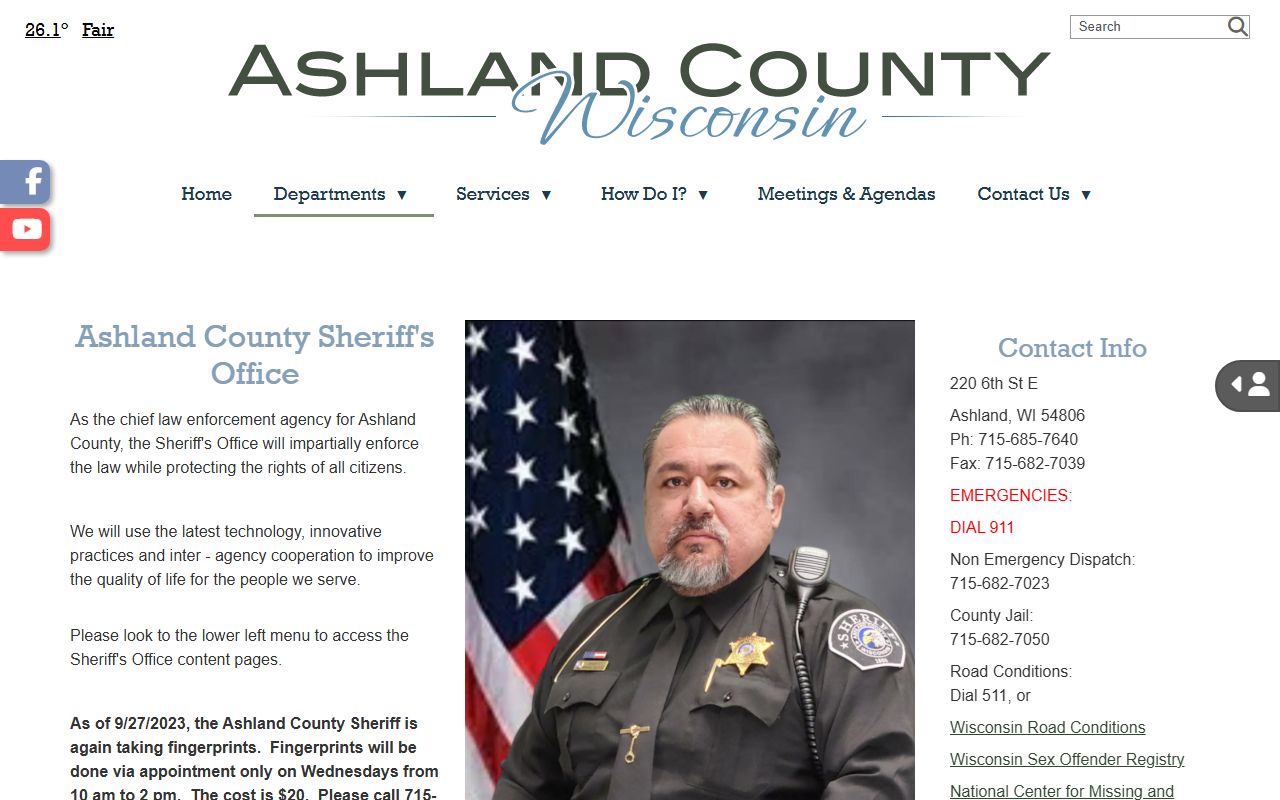
That image fits the first stop in a county search because the sheriff usually holds the original incident file.
The open records page at ashlandcountywi.gov/sheriff_open_records is the source for the second image below.
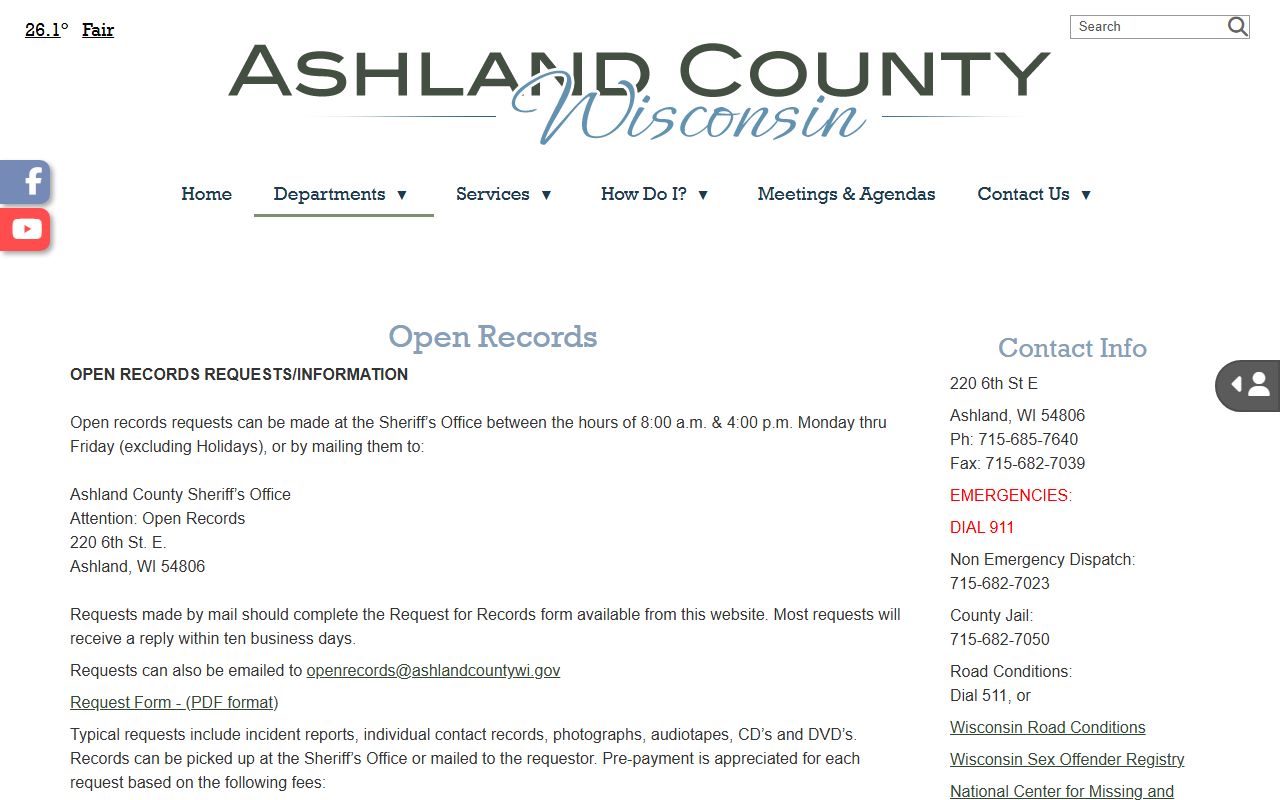
That page is the cleaner route when you want the request process instead of a general office summary.
Ashland County Records Requests
Ashland County records requests go through the sheriff's office and most requests receive a reply within 10 business days. The office hours are 8 a.m. to 4 p.m. Monday through Friday. Requests can be made by email or mail, and the office also accepts written requests. The open records email is openrecords@ashlandcountywi.gov. That gives you more than one way to ask, but the office still controls release after review.
Fees are straightforward. Incident reports are $0.25 per page, and CDs or DVDs are $5. Accident reports are better handled through the Wisconsin DOT crash portal at app.wi.gov/crashreports once you have the report number or other crash details. If you only need to know whether a record exists, the county's slower paper path may not be the best choice. A crash file or a law enforcement report may live in a different system than the blotter note itself.
These details help most when you write the request:
- Date or date range
- Address or location description
- Name of the person or people involved
- Report number, if known
- Whether you need a copy or a simple confirmation
The sheriff is the legal custodian under Wis. Stat. 19.33, so the office is the final gatekeeper for release. That is why a clear request is worth more than a broad one. A focused ask helps the staff find the file and helps you get back a usable record instead of a vague reply.
Ashland County Police Blotter and Courts
When an Ashland County police blotter item moves into court, the next stop is Wisconsin Circuit Court Access at wcca.wicourts.gov. That site shows case status, filings, and docket entries across Wisconsin counties. The Wisconsin Court System at wicourts.gov gives the broader court structure, forms, and self-help pages. That matters in a county search because the sheriff file may tell you what happened, while the court file shows what happened next.
The State Law Library county guide at wilawlibrary.gov/topics/county.php is another useful path when you need the correct local office. It can help you move from a sheriff record to a clerk or court source without wandering through unrelated pages. In a place like Ashland County, that small step can save a call and keep the search focused on the right record.
If the issue is a crash, the state crash portal at app.wi.gov/crashreports is usually the better route than the sheriff's desk. A crash report and a police blotter entry overlap, but they are not the same file. Use the crash system when the event began on the road and the sheriff record when the event began in the county file.
The old Wisconsin access case at law.justia.com/cases/wisconsin/supreme-court/1979/76-724-7.html is useful background for why arrest list style records stay open in Wisconsin. That tradition still shapes how local agencies handle public access today.
Ashland County Police Blotter Fees
Ashland County charges $0.25 per page for incident reports and $5 for CDs or DVDs. That is a fairly simple fee structure, but the county still reviews the record before release. If the file needs redaction, or if it contains protected material, the review can take time. The sheriff's office also directs people to the Wisconsin DOT crash portal for accident reports, which keeps crash files out of the law enforcement queue when they belong in the state system instead.
Wisconsin public records law allows fees tied to actual cost in some cases, and it gives requesters a right to inspect records under the law. The balance in Wis. Stat. ch. 19 is part access and part limits, which means the county can release the file while still redacting sensitive pieces. That is normal for a police blotter search. It is also why a short file may be easy to get while a fuller packet takes longer.
For a requester, the practical move is simple. Ask first for the report you actually need, then decide whether you also want the crash file, the court docket, or a clerk copy. That keeps the cost down and helps the office find the right file the first time. In a county this size, a precise request usually works better than a broad one.
Ashland County Public Records Limits
Ashland County police blotter records sit inside Wisconsin's public access rule, which starts with a presumption of release under Wis. Stat. 19.31. The county still has to protect information that the law keeps private, and that is where Wis. Stat. 19.36 and Wis. Stat. 19.37 come in. Juvenile details, sensitive victim information, and active investigation material can be withheld or redacted. A limited copy is not a refusal by default. It is often the lawful middle ground.
For a plain explanation of the rules, the Department of Justice Office of Open Government at doj.state.wi.us/office-open-government and its resource page at doj.state.wi.us/office-open-government/office-open-government-resources are the best statewide references. They help when a sheriff response comes back with redactions or a delay. They also help you understand why some lines in a blotter record stay open while some details stay closed.
For a criminal history issue, the DOJ record check system at recordcheck.doj.wi.gov is the separate tool. It is not a blotter search, but it can help when you need to know whether a county incident ended in an arrest or another history entry. That can be useful when you are moving from the report to the broader legal trail.
Note: The sheriff's office is the legal custodian, so the request still has to clear that office before anything is released.
Search Ashland County Police Blotter
If you are still looking for the right record, start with the sheriff's open records page, then use the county clerk or WCCA if the incident became a case. That sequence keeps the search short. It also keeps you from sending the same request to the wrong office twice. In Ashland County, the office that wrote the first note is usually the office that can point you to the next step.
When the record is a crash, use the state portal. When it is a court case, use WCCA. When it is a sheriff report, go straight to the open records contact and ask for the specific file. That is the shortest practical path through an Ashland County police blotter search, and it is the one most likely to return a useful record.