
Search La Crosse Police Blotter
La Crosse police blotter searches usually start with the city police department, then move to the county side or historical archives if the record goes beyond the current report. That is important in La Crosse because the city has a long police history, and some files are still tied to older archive systems instead of a quick online portal. If you need a report or a case trail, begin with the office that handled the event. The record path gets easier once you separate current police work from historical material.
La Crosse Police Blotter Overview
La Crosse Police Blotter Sources
The La Crosse Police Department is the first stop for city incidents. The official city website at cityoflacrosse.org gives the current department path, and the department is at 400 La Crosse St., La Crosse, WI 54601. The non-emergency phone is 608-785-9191. That is the right lane when the incident happened inside city limits and you want the current report trail instead of an old archive file.
La Crosse County is also part of the search. The county sheriff is at 333 Vine St., La Crosse, WI 54601, and county records can matter when the call happened outside the city or turned into a county matter. The county sheriff page is not listed as a direct URL in the research, so the city and archive resources matter even more. The point is simple. Use the office that actually wrote the first note.
The county government source at lacrossecounty.org is the first image anchor for a La Crosse search.
That image is a good county-side fallback when the file lives outside the city desk and the county source is the better first stop.
La Crosse also has historical records that matter. The La Crosse Public Library Archives preserve police records from 1871 through 1977, and the archive page at archives.lacrosselibrary.org/collections/public-records/la-crosse-series-003/ is the strongest historical source in the research. That collection includes police journals, logs, docket books, arrest logs, mugshots, ambulance logs, traffic violation registers, accident reports, and incident reports. For old cases, that is often the key to the whole file trail.
La Crosse Police Blotter Requests
Current La Crosse police blotter requests start with the city police department. Historical records start with the library archives. That split matters because a current incident and a 1950s arrest log do not live in the same system. If your search is about a recent report, the city police office is the right first desk. If it is older, the archives may be the better route.
The research says standard processing is about 10 business days for current requests. That gives you a workable baseline. It does not mean every file comes back on that schedule, but it gives you a fair expectation. Keep the request narrow and give the office the date, location, and name if you have it. That is the best way to keep the request from wandering.
If you need a link to the archive trail, the historical record collection at archives.lacrosselibrary.org/collections/public-records/la-crosse-series-003/ is the place to check. It is not a city report portal, but it is part of the public record path and it helps when the incident falls outside the current system. That can save a lot of time when the file is old or the police desk has pointed you to historical records.
One practical move is to separate the current request from the archive request. A recent report needs the city desk. A decades-old log needs the library. Treating them as different searches usually gets a better answer from the start.
La Crosse Police Blotter Archives
The La Crosse Police Archives page is one of the strongest historical resources in the state. The archive run from 1871 to 1977 includes a wide set of police records, and the collection description at archives.lacrosselibrary.org/collections/public-records/la-crosse-series-003/ explains what is in it. If you need a police journal, a mugshot, an ambulance log, or an old incident report, that archive may be the right place to look first. It is a different job from a current records request.
The Wisconsin Historical Society also keeps police records resources through its digital collections at digicoll.library.wisc.edu/cgi/f/findaid/findaid-idx?c=wiarchives. That resource is useful when you need a broader state history path or a second place to check for older material. It is not the same as a city police desk, but it helps when the search has moved out of current operations and into history.
The archive page at archives.lacrosselibrary.org/collections/public-records/la-crosse-series-003/ is the historical source behind the image below.
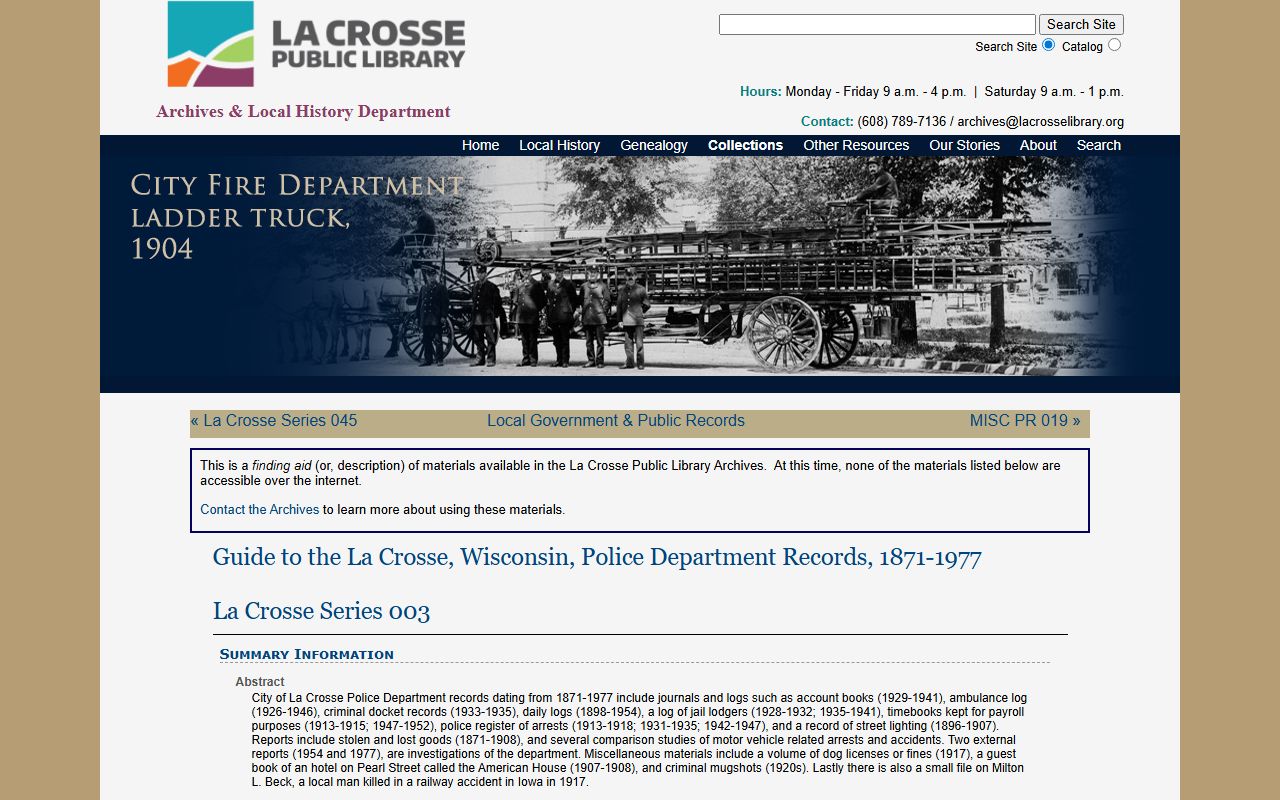
That image fits the older record trail because it points to the archive source that holds the historic material and the longer paper trail.
La Crosse Police Blotter and Courts
When a La Crosse police blotter entry turns into a case, WCCA is the next place to look. Wisconsin Circuit Court Access at wcca.wicourts.gov can show the docket trail after the police report is done. That matters when a city note becomes a charge or a later court result. The Wisconsin Court System at wicourts.gov gives the broader court path if you need forms or self-help material.
The county court records path also matters. The research notes say La Crosse County Clerk of Courts is at the county courthouse and the phone is (608) 785-9590. That office helps when the police report points into a court file rather than just a city record. The broader idea is the same as everywhere else. The police report starts the story. The court file finishes it.
If the incident is a crash, the state crash portal at app.wi.gov/crashreports is the better route after you have the report number. If you need a criminal history check, the DOJ record check system at recordcheck.doj.wi.gov is separate from the police search and serves a different purpose. That keeps the trail from mixing report copies, court records, and background checks into one request.
La Crosse Public Records Limits
Wisconsin public records law starts with access. The rules in Wis. Stat. Chapter 19 cover the presumption of release, the fee rule, the limits, and the enforcement path. In practice, that means La Crosse can release a police blotter record, but it can still redact juvenile details, sensitive victim information, or active investigation material when the law requires it. That is normal and expected.
The Department of Justice Office of Open Government at doj.state.wi.us/office-open-government and its resource page at doj.state.wi.us/office-open-government/office-open-government-resources are useful when a response is delayed or when a file comes back partially redacted. Those pages help explain why the city may release one piece and hold another.
The 1979 Wisconsin access case at law.justia.com/cases/wisconsin/supreme-court/1979/76-724-7.html remains useful background. It helps explain why blotter-style information has long been treated as public in Wisconsin. For an older city record, that history can matter as much as the report itself.
Note: La Crosse historical records and current police records live in different places, so start by matching the date to the right system.
For a county-side visual checkpoint, the La Crosse County government image below is another useful source link.
It fits the county side of the search and helps when the city file is not the whole story.