
Search Eau Claire Police Blotter
Eau Claire police blotter searches usually start with the city police desk, then branch to the county portal, the university office, or the court file if the incident moved on. That is the way local records often work here. A call downtown may stay with Eau Claire Police, while a campus event may go to UW-Eau Claire, and a later charge may show up in court. If you want the report, the status, or the next step after the call, begin with the office that actually handled it.
Eau Claire Police Blotter Overview
Eau Claire Police Blotter Access
The city police page at eauclairewi.gov/government/our-divisions/police-department is the main city entry point for police records. The office sits at 721 Oxford Ave., Suite 1400, Eau Claire, WI 54703. The non-emergency line is (715) 839-4972, and the city switchboard is (715) 839-4902. When a blotter item belongs to city police, this is the desk that can tell you what exists and what is ready for release.
The ECPD app page at joinecpd.org/ecpdapp gives another city path for requests, alerts, and reports, and the image below points back to that official source.
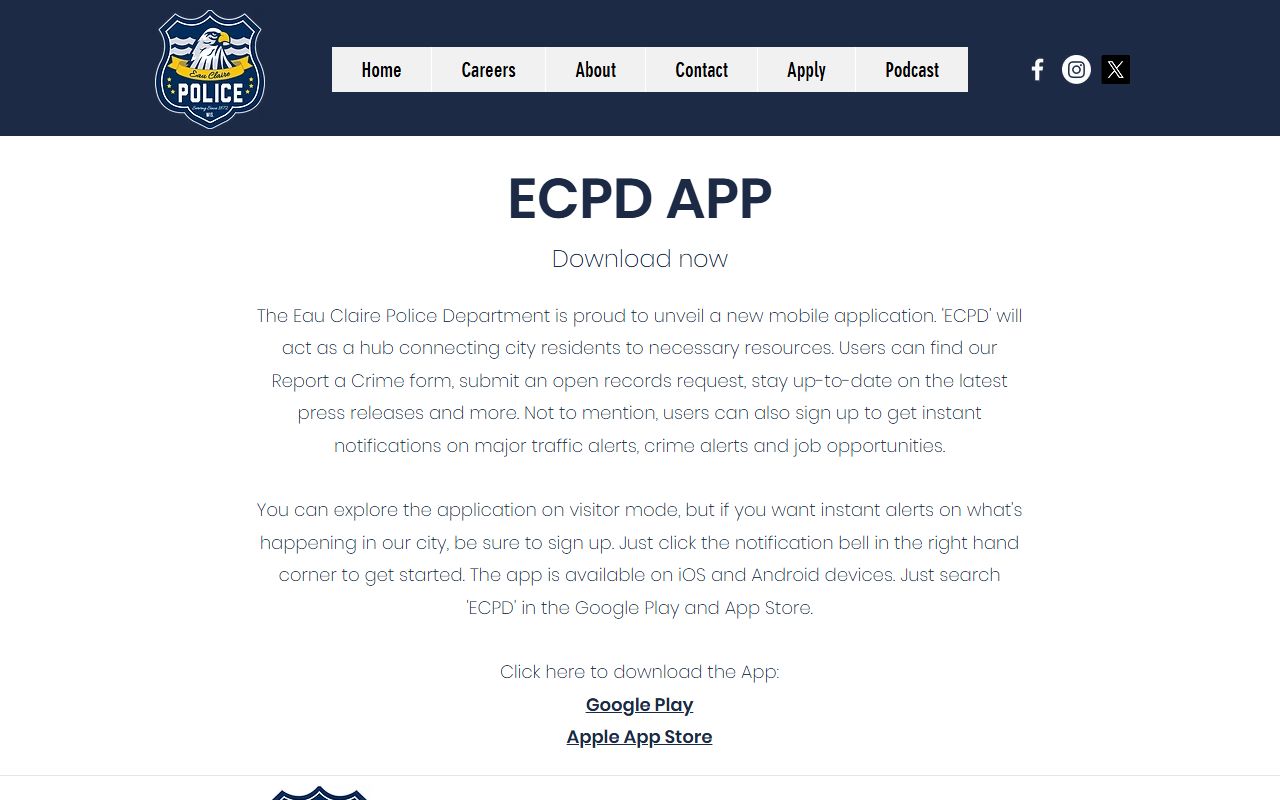
That route is useful when you want a faster first look at a local police record or a simple request path.
The city and county records portal at eauclairewi.justfoia.com keeps the request process in one place, and the image below points back to that source page.
That portal is helpful when the record may sit with a city desk, a county desk, or a shared records team.
Eau Claire Police Blotter Requests
Good requests are short and precise. Eau Claire records staff want the date, the time, the case number if you know it, the people involved, and the location. If you have all five, the search moves faster. If you do not, the office may still help, but it will need enough detail to separate your incident from the next one with a similar name or address. Requests are processed in order received, so a clear request is the best way to avoid delay.
Eau Claire also notes that electronic delivery is free for some records. That matters when the file can be sent without paper or extra handling. If you want to know whether a report is ready, ask first before you drive over. The city police office and the county sheriff are both on Oxford Avenue, but the record you need can still sit in only one of them. The city police can be reached at (715) 839-4972, and the sheriff can be reached at (715) 839-3808.
Before you send the request, line up the facts.
- Date and time of the incident
- Location or block
- Case number, if available
- Names of the people involved
- Whether you need a report, status check, or copy
If you are asking about a campus event, send the request to UW-Eau Claire Police instead of city police. That office has its own process at uwec.edu/offices-services/uw-eau-claire-police. A campus record can look local, but the right desk still matters.
Eau Claire Police Blotter and UW-Eau Claire
UW-Eau Claire is not part of the city police chain. That split matters when a blotter item comes from housing, a campus lot, a student event, or another university property. The university police page at uwec.edu/offices-services/uw-eau-claire-police is the correct starting point for those records. If you ask the city for a campus file, you may just slow yourself down.
Once a city incident turns into a court matter, the next stop is Wisconsin Circuit Court Access at wcca.wicourts.gov. That statewide search can show the case number, the filing date, and the hearing trail. The Wisconsin Court System at wicourts.gov gives the broader court framework, and the Eau Claire County Clerk of Courts at (715) 839-4815 can help if you need the local file path or a certified copy.
The county law library directory at wilawlibrary.gov/topics/county.php is useful when you need the right local office fast. It is not a substitute for the clerk, but it can point you in the right direction when a police blotter note has already become a court issue. A single call can touch campus, city, county, and court records in one day.
Eau Claire Police Blotter Search
The best search path depends on the type of record. For a crash, use the Wisconsin DOT crash portal at app.wi.gov/crashreports. For a city report, use the police page or the JustFOIA portal. For a campus incident, use UW-Eau Claire Police. For a case that moved into court, use WCCA. Those tools work together, and none of them replaces the others. The trick is knowing which one fits the event first.
If your first search comes up thin, do not widen it too much. Add the location, the date, and the agency that wrote the file. Eau Claire is small enough that a careful search often works, but it is busy enough that a broad one can send you in circles. A clean request saves time and gives the records clerk something real to work with.
For more state guidance, the Wisconsin Department of Justice Office of Open Government at doj.state.wi.us/office-open-government and its resources page at doj.state.wi.us/office-open-government/office-open-government-resources explain how release and redaction work. Those pages are useful when you want to know why one file came back quickly and another did not.
Eau Claire Public Records Limits
Wisconsin public records law starts with access. Wis. Stat. 19.31 favors the greatest possible information about government work, and that is why a police blotter request can work in the first place. The law also allows limits when safety, privacy, or another statute calls for them. That means a report can be public while some lines, names, or images stay hidden.
The full statutory set at Wisconsin Statutes Chapter 19 covers the access rule, fee rule, limits, and enforcement. Sections 19.35, 19.36, and 19.37 matter most once you move from a simple request to a file that needs redaction or a formal review. The Wisconsin Supreme Court case Newspapers, Inc. v. Breier is still a useful reminder that arrest lists and blotter style records have long been treated as public in Wisconsin.
If a request stalls, the county legal resources page at wilawlibrary.gov/topics/county.php and the state open government pages can help you decide the next move. That matters most when a city report, a campus record, and a court file are all part of the same incident. The paper trail is easier to follow when you keep the offices separate and the facts tight.
Note: A report can be public even when parts of it are redacted or delayed for review.